 Eleanor Voss
F1 SPECIAL: FERRARI’S CIVIL WAR
Is Charles Leclerc becoming Ferrari’s biggest liability? Frédéric Vasseur had already delivered the lecture. Charles Leclerc had already heard it. Lewis Hamilton had already explained why Ferrari needed clearer rules.
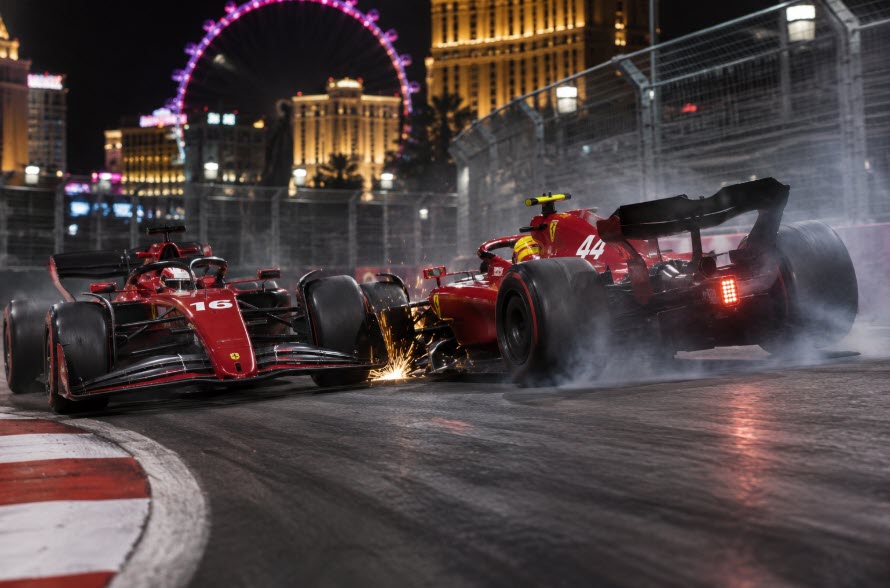
Then, on Lap 38 of the Las Vegas Grand Prix, Leclerc ran his Ferrari into the side of Hamilton’s car. The seven-time world champion spun. Leclerc collected a 10-second penalty. Ferrari finished seventh and tenth, salvaging seven points from a race in which both cars had started outside the top ten.
And Vasseur, the man responsible for managing two of Formula 1’s most formidable egos, found himself repeating a conversation that should have been settled weeks earlier. “Charles, I want to see you just after the race, before everything,” he ordered over the team radio. Not the sort of invitation a driver hopes to receive after a Grand Prix.
Ferrari remains second in the Constructors’ Championship, comfortably ahead of Red Bull. Mercedes has already taken the title. There is no championship miracle left to chase, only the considerable business of protecting second place and preparing for 2027. Yet Ferrari’s most immediate threat is not coming from another garage. It is coming from the relationship between its own drivers.
And after three increasingly expensive confrontations, the question is becoming difficult to avoid: has Charles Leclerc become Ferrari’s biggest liability?
Three Races, Three Warnings
Monza was the first unmistakable warning. At Ferrari’s home Grand Prix in September, Hamilton and Leclerc started side by side on the second row. Their opening-lap battle through the first chicane ended with Hamilton in the gravel, falling from fourth to tenth. Leclerc subsequently crashed out on Lap 2. Hamilton recovered to sixth.
The stewards took no further action over their opening-lap confrontation. That matters. An aggressive maneuver is not automatically an infringement, and the competing interpretations of the incident reflected genuine ambiguity.
But Leclerc later acknowledged that he had gone too far. Hamilton, meanwhile, raised a more consequential complaint: Ferrari lacked the written rules of engagement he had known at Mercedes.
The drivers held discussions with senior Ferrari management, including chairman John Elkann, chief executive Benedetto Vigna, and Vasseur. The understanding appeared to be restored. Then came Mexico City.
Hamilton started from pole. Leclerc lined up third. Ferrari briefly had the race exactly where it wanted it, with both cars in the lead. Instead, their first-lap fight at Turn 4 opened the door for Max Verstappen.
Leclerc went off track and retained an advantage. The stewards imposed a five-second penalty, reduced from the usual ten-second baseline because Hamilton had also entered the corner too quickly and run wide. That distinction is important. The officials did not conclude that Hamilton was blameless in the sequence.
Leclerc nevertheless accepted that his penalty was deserved. Hamilton finished second, Leclerc fourth, and Verstappen won. Hamilton’s complaint was no longer simply about being forced off the road. It was about Ferrari surrendering an opportunity to win because its drivers had treated each other as their principal opposition.
Vasseur summoned another discussion, this time in Brazil. He said the meeting had clarified everyone’s position. Ferrari, he insisted, came first. Two weeks later, the Ferraris collided in Las Vegas. Whatever was clarified in Brazil did not survive contact with Turn 7.

The Radio Was Already Boiling
Ferrari’s problems in Las Vegas began before the race. Both cars failed to reach Q3. The team’s inability to organize an effective qualifying tow contributed to a starting position that left Hamilton and Leclerc fighting through traffic rather than competing at the front.
The race then produced the extraordinary passing and repassing associated with Formula 1’s 2026 energy-deployment regulations. Cars could gain an advantage on one straight and surrender it on the next. Position was unusually fluid. Drivers were repeatedly forced to distinguish between a genuine opportunity and a temporary difference in available electrical power.
That environment rewarded opportunism. It also punished poor judgment. Leclerc complained over the radio about Hamilton’s positioning as the Ferraris fought around Oscar Piastri’s McLaren. “He needs to be careful with the squeezing,” Leclerc warned.
Hamilton was equally unhappy. As the two Ferraris approached the McLarens, he demanded that the team tell Leclerc to back off. Neither message suggests a functioning partnership.
Leclerc’s warning concerned the space Hamilton was leaving during their wheel-to-wheel racing. It was not evidence of an intention to cause a collision. But the hostility was audible long before the impact.
Hamilton had also received a separate 10-second penalty after leaving the track and gaining an advantage during a battle with Lando Norris. He considered that punishment harsh, particularly given his account of trying to avoid contact.
The resulting pit-stop complications sent him down the order, but he recovered impressively. By Lap 34, Hamilton had passed Leclerc for seventh. Four laps later, after both Ferraris had cleared Pierre Gasly, Leclerc attacked Hamilton on the inside at Turn 7.
The maneuver ended with contact with Hamilton’s right-rear wheel, followed by a spin. The FIA’s written decision was unusually emphatic. Leclerc had initiated the attack from a considerable distance behind. His front axle was not sufficiently alongside Hamilton’s car at the apex to establish entitlement to the corner.
The stewards found him wholly to blame. This was not an unfortunate racing incident in which responsibility was evenly distributed. It was a failed overtaking attempt, and the governing body’s finding was unequivocal. Leclerc crossed the finish line sixth but dropped to tenth after his penalty. Hamilton recovered to seventh.
Ferrari’s afternoon had become another exercise in repairing damage inflicted from within.

Leclerc Has Earned His Place, Not Immunity
There is a temptation to turn Leclerc into the villain of this story. That would be convenient. It would also be lazy. Leclerc has spent years carrying Ferrari’s ambitions through periods when the machinery couldn’t deliver. His speed, commitment, and willingness to attack have made him one of the team’s most valuable assets.
Ferrari did not sign Hamilton to replace Leclerc’s competitive instincts with obedience. And there is no convincing evidence that Leclerc’s recent mistakes stem from a calculated campaign to establish psychological dominance over his teammate. But there is a legitimate question about whether he has become too willing to gamble Ferrari’s collective interests on his own immediate advantage.
Consider the progression. At Monza, Leclerc accepted that his driving had been too aggressive. In Mexico, he acknowledged a deserved penalty after a battle that helped cost Ferrari the victory. In Las Vegas, he attempted an overtake that the team had specifically instructed him not to make.
That final detail changes the argument. Vasseur confirmed afterward that Ferrari had told Leclerc not to overtake Hamilton because the team wanted to avoid compromising both cars in the unpredictable racing conditions. Leclerc attacked anyway.
The problem was no longer merely a driver’s judgment of braking distance or corner entitlement. It was a driver disregarding a direct instruction intended to protect the team’s result. Afterward, Leclerc accepted responsibility and expressed embarrassment.
He suggested Hamilton might not have seen him approaching, but did not use that explanation to reject the stewards’ ruling. There is no reason to doubt his regret. However, there is every reason to question its practical value. Ferrari has heard the apologies before.
Vasseur’s Authority Is Now on Trial
Vasseur’s public response was furious. He described the collision as completely unacceptable and emphasized the obligations Ferrari’s drivers have to the people working at Maranello, its sponsors, and everyone invested in the team’s success. His anger was understandable, but his surprise was less convincing.
Ferrari had already experienced two major incidents involving these drivers. It had already held meetings. Vasseur had already publicly explained the importance of mutual respect. In Las Vegas, Ferrari went further by issuing a specific instruction. It still failed. This is where the responsibility begins to move beyond Leclerc.
A team principal cannot control every decision made at racing speed. Nor should he attempt to eliminate the competitive tension that makes two elite drivers valuable. But when instructions repeatedly fail to produce the intended behavior, management must examine the effectiveness of its own authority.
Ferrari’s approach has relied heavily on discussions, mutual understanding, and appeals to the team’s history. Those are reasonable starting points. Yet, they are not an inexhaustible management strategy.
Vasseur has argued that freezing positions is not always practical. He is right. Formula 1 races are too dynamic for rigid instructions to cover every situation, particularly under the unusual 2026 regulations.
But there is a considerable distance between allowing drivers to race and allowing them to disregard instructions without meaningful consequences. The distinction is not philosophical. It is operational.
If Ferrari’s drivers cannot distinguish between a legitimate racing opportunity and an unacceptable risk to both cars, the team needs a more enforceable framework. That does not necessarily mean permanent team orders or designating Hamilton as the favored driver. It means establishing boundaries whose authority survives the moment a driver sees an opening.
Vasseur now faces an uncomfortable choice. He can continue treating each confrontation as an isolated lapse of judgment, or acknowledge that the pattern has become a management failure. His reputation will increasingly depend on the answer.

Hamilton Is Not Bluffing About His Frustration
Hamilton’s post-race reaction was revealing precisely because he refused to turn it into another public argument. Asked about the collision, he directed questions toward Ferrari.
Asked whether the team needed firmer rules, he offered something considerably more damaging than an angry accusation. “I’ve done all I can, and I’ve said everything and more.” That is the language of someone who believes the problem has already been explained.
Hamilton is hardly beyond criticism. His own penalty in Las Vegas cost him time, and his aggressive defense against Norris drew scrutiny simply because he disagreed with the stewards. But his wider position has become increasingly difficult to dismiss.
He joined Ferrari in 2025 amid enormous expectations and endured a miserable first season. His improvement in 2026 has been substantial: a maiden Ferrari victory in Barcelona, pole position in Mexico City, and third place in the Drivers’ Championship after Las Vegas. He has 267 points to Leclerc’s 250.
The suggestion that Hamilton is merely an aging superstar unable to accept his teammate’s speed does not survive that comparison. Nor does the evidence support speculation that he is preparing to abandon Ferrari.
His contract runs through at least 2027. Before Las Vegas, he said he hadn’t even considered renewal discussions and saw no immediate reason to start them. Former Formula 1 figures can speculate about retirement. That does not make retirement Hamilton’s plan.
The more credible concern is that repeated confrontations could erode his confidence in Ferrari’s ability to manage its own drivers. A seven-time world champion does not need preferential treatment. He does need to believe that an agreement reached in a meeting will still mean something when the lights go out.
Ferrari Can Afford the Points, Not the Habit
Ferrari leaves Las Vegas with 517 Constructors’ Championship points. Red Bull has 440. McLaren has 431.
With Qatar and Abu Dhabi remaining, Ferrari’s 77-point advantage over Red Bull is substantial. The team is not suddenly facing an imminent collapse to third place. Pretending otherwise would manufacture a championship crisis that does not exist. But the standings are not an excuse for complacency.
Constructors’ Championship positions influence the distribution of Formula 1’s commercial revenues. Second place also matters to Ferrari’s employees, its sponsors and the credibility of its recovery.
Hamilton made that point before the race, emphasizing how much securing second would mean to the people working at Maranello. And the team’s responsibilities extend beyond the current season.
Ferrari needs both drivers contributing to the development of its 2027 car. It needs reliable feedback, coordinated race execution, and a working relationship that can survive disagreements. It does not need another internal confrontation consuming its leadership’s attention.
There is a distinction between having enough championship points to absorb a mistake and having a team culture that makes mistakes unnecessarily repeatable. Ferrari currently enjoys the first luxury. It cannot afford the second.

The Wrong Man May Be Asking for Forgiveness
Leclerc deserves criticism for Las Vegas. The stewards found him responsible; Vasseur confirmed he ignored an instruction, and the resulting penalty cost Ferrari points. His record across Monza, Mexico City, and Las Vegas makes his judgment in question.
But calling him Ferrari’s biggest liability risks allowing the person ultimately responsible for the team’s discipline to escape examination. Vasseur has now had multiple opportunities to establish an effective understanding between his drivers. Leclerc has repeatedly apologized or acknowledged mistakes. Hamilton has repeatedly requested clearer boundaries. And Ferrari has repeatedly returned to the same problem.
The next collision cannot reasonably be treated as another unfortunate misunderstanding. There are two races remaining. Ferrari has a valuable championship position to protect and two drivers capable of delivering considerably more than seventh and tenth.
Leclerc does not need to surrender his ambition. Hamilton does not need to surrender his right to race. Vasseur does not need to appoint a permanent number one. But somebody at Ferrari must finally establish the difference between racing for the team and racing against it.
Leclerc has now demonstrated that Ferrari’s instructions can be ignored. Vasseur must demonstrate that they cannot be ignored without consequences. Otherwise, Ferrari’s biggest liability may not be the driver who refuses to yield. It may be the team principal who keeps asking him nicely.
Sources: FIA Las Vegas stewards’ decision · F1 Leclerc interview · Sky Sports post-race reporting · F1 Vasseur interview · F1 Mexico City reporting · F1 Monza reporting · Official team standings · Official driver standings · Reuters.
Related articles




Motor Racing Betting Guide: How to Bet on Motorsports
Motor racing offers one of the most exciting environments in sports betting. Unlike traditional team sports, motorsport competitions feature large fields of drivers competing simultaneously across multiple laps or stages. This creates a wide variety of betting markets beyond simply predicting the race winner. From Formula 1 and NASCAR to IndyCar, MotoGP, and rally racing, […]

MotorSports Betting Hub
Motorsports betting offers one of the most exciting and dynamic wagering experiences in sports. From the precision of Formula 1 to the intensity of NASCAR, the strategy of IndyCar, and the unpredictability of rally racing, motorsports provide a wide range of betting opportunities across multiple racing series. Unlike traditional team sports, motorsports betting focuses on […]